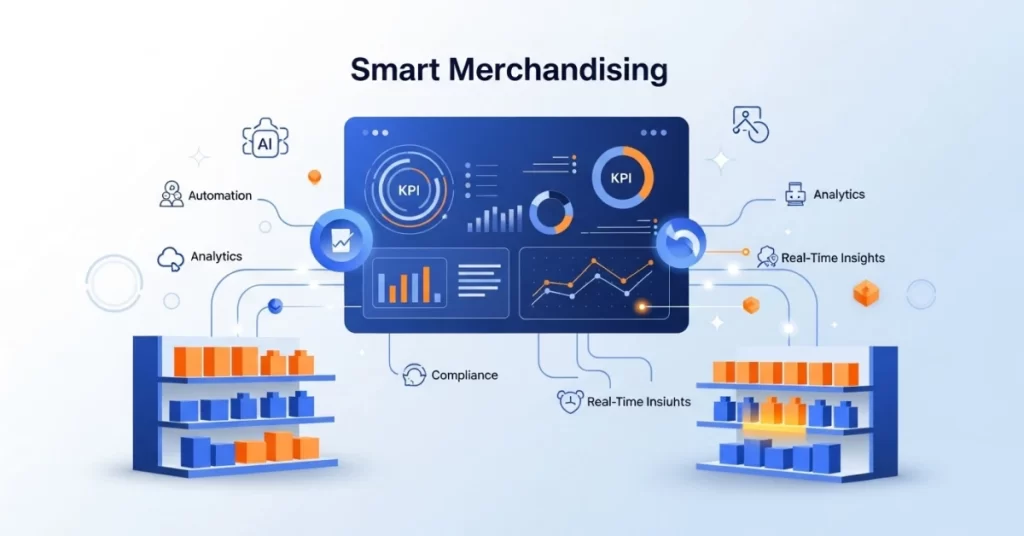



Image recognition in CPG market represents one of the most transformative technologies reshaping consumer packaged goods retail today. This advanced AI-powered solution enables brands and retailers to automatically analyze shelf conditions, monitor product placement, track inventory levels, and optimize merchandising strategies through computer vision technology.
What is Image Recognition in the CPG Market?
Image recognition in CPG market refers to the application of artificial intelligence and computer vision technologies to analyze visual data from retail environments. This technology processes images captured from store shelves, displays, and retail spaces to extract actionable insights about product availability, brand compliance, competitive positioning, and consumer behavior patterns.
[Görsel Önerisi: Modern retail store with AI cameras analyzing shelves – Alt Text: “AI-powered image recognition technology analyzing CPG products on retail shelves”]
The technology combines machine learning algorithms, deep neural networks, and advanced pattern recognition to identify products, read labels, assess shelf conditions, and generate real-time analytics that drive strategic decision-making across the consumer packaged goods supply chain.
How Does Image Recognition Transform CPG Operations?
Real-Time Inventory Management
Image recognition in CPG market revolutionizes inventory tracking by providing instant visibility into stock levels across thousands of retail locations. Traditional manual audits that once took hours can now be completed in minutes through automated image analysis.
Key capabilities include:
- Automated out-of-stock detection with 95%+ accuracy
- Real-time planogram compliance monitoring
- Dynamic pricing optimization based on shelf conditions
- Competitive product placement analysis
Enhanced Merchandising Intelligence
The technology delivers unprecedented insights into merchandising effectiveness, enabling CPG brands to optimize their retail presence systematically.
Critical merchandising metrics tracked:
- Share of shelf measurements
- Product facing counts and orientation
- Promotional display compliance
- Brand block integrity assessment
[Görsel Önerisi: Dashboard showing real-time shelf analytics and compliance metrics – Alt Text: “CPG image recognition dashboard displaying shelf compliance and inventory analytics”]
Market Size and Growth Projections
According to MarketsandMarkets research, the global image recognition in CPG market size exceeded $1.4 billion in 2020 and is projected to reach approximately $3.7 billion by 2025, representing a compound annual growth rate (CAGR) of 21.7%.
| Market Segment | 2020 Value | 2025 Projection | CAGR |
|---|---|---|---|
| Hardware Components | $560M | $1.48B | 21.4% |
| Software Solutions | $504M | $1.33B | 21.8% |
| Services & Support | $336M | $890M | 22.1% |
Regional Market Distribution
The North American market currently dominates image recognition in CPG market adoption, accounting for approximately 40% of global revenue, followed by Europe (28%) and Asia-Pacific (22%). However, the Asia-Pacific region shows the highest growth potential with an expected CAGR of 24.3% through 2025.
Key Applications Driving Market Growth
1. Inventory Analysis and Optimization
Image recognition in CPG market enables sophisticated inventory management through:
- Automated stock counting: Reduces manual labor costs by up to 75%
- Predictive restocking: Prevents out-of-stock situations before they occur
- Demand forecasting: Analyzes visual trends to predict consumer behavior
- Supply chain optimization: Streamlines distribution based on real-time shelf data
2. Product and Shelf Monitoring Analysis
Advanced monitoring capabilities include:
- Planogram compliance verification: Ensures products are positioned according to category management strategies
- Price tag accuracy: Validates pricing consistency across retail locations
- Product condition assessment: Identifies damaged or expired products automatically
- Competitive intelligence: Tracks competitor product placement and pricing strategies
3. Consumer Emotion and Behavior Gauging
Cutting-edge applications analyze:
- Shopping pattern recognition: Identifies high-traffic areas and optimal product placement zones
- Consumer interaction tracking: Measures product engagement and selection patterns
- Demographic analysis: Provides insights into customer segments and preferences
- Purchase decision factors: Analyzes visual cues that influence buying behavior
Technology Components and Infrastructure
Hardware Requirements
Image recognition in CPG market implementations typically require:
Camera Systems:
- High-resolution digital cameras (minimum 4K resolution)
- Wide-angle lenses for comprehensive shelf coverage
- Night vision capabilities for 24/7 monitoring
- Weather-resistant housings for various retail environments
Processing Equipment:
- Edge computing devices for real-time analysis
- Cloud connectivity modules for data synchronization
- Storage systems for image archiving and historical analysis
- Power management solutions for continuous operation
Software Solutions
Core Software Components:
- Machine learning algorithms trained on CPG-specific datasets
- Computer vision libraries optimized for retail environments
- Data analytics platforms for insight generation
- Integration APIs for ERP and POS system connectivity
[Görsel Önerisi: Technical architecture diagram showing image recognition system components – Alt Text: “Complete technical architecture of CPG image recognition system infrastructure”]
Implementation Strategies and Best Practices
Phase 1: Pilot Program Development
Successful image recognition in CPG market implementation begins with strategic pilot programs:
Pilot Program Checklist:
- [ ] Select 3-5 representative retail locations
- [ ] Define specific KPIs and success metrics
- [ ] Establish baseline measurements for comparison
- [ ] Train staff on new technology workflows
- [ ] Implement feedback collection mechanisms
Phase 2: Technology Integration
Critical Integration Steps:
- System Architecture Design: Develop scalable infrastructure supporting current and future needs
- Data Pipeline Creation: Establish secure, efficient data flow from cameras to analytics platforms
- API Development: Create robust interfaces connecting image recognition systems with existing retail technology stack
- Security Implementation: Deploy encryption, access controls, and compliance measures
Phase 3: Scale and Optimization
Scaling Best Practices:
- Gradual rollout across retail network (10-20 stores per month)
- Continuous algorithm training with new product introductions
- Regular performance monitoring and system tuning
- Staff training programs for maximum adoption
Addressing Common Implementation Challenges
Technical Challenges and Solutions
Challenge: Lighting Variability
- Solution: Deploy adaptive algorithms that adjust to different lighting conditions
- Implementation: Use HDR cameras with automatic exposure compensation
Challenge: Product Recognition Accuracy
- Solution: Continuous machine learning model training with store-specific data
- Implementation: Establish feedback loops for misidentification correction
Challenge: Network Connectivity Issues
- Solution: Implement edge computing for offline operation capabilities
- Implementation: Deploy local processing units with cloud synchronization
Operational Challenges
Staff Resistance and Training:
Many retail employees initially resist new technology implementations. Successful adoption requires:
- Comprehensive training programs highlighting personal benefits
- Clear communication about job enhancement rather than replacement
- Ongoing support and troubleshooting assistance
- Recognition programs for successful technology adoption
Data Privacy and Compliance:
Image recognition in CPG market implementations must address:
- Consumer privacy protection measures
- GDPR and regional data protection compliance
- Secure data storage and transmission protocols
- Clear opt-out mechanisms for concerned consumers
ROI Analysis and Business Impact
Quantifiable Benefits
Organizations implementing image recognition in CPG market solutions typically achieve:
Operational Efficiency Gains:
- 60-80% reduction in manual audit time
- 25-35% improvement in inventory accuracy
- 15-20% decrease in out-of-stock incidents
- 30-40% faster planogram compliance verification
Revenue Impact:
- 5-12% increase in sales through optimized product placement
- 8-15% improvement in promotional effectiveness
- 10-18% reduction in inventory carrying costs
- 20-25% decrease in manual labor expenses
Cost-Benefit Analysis Framework
| Investment Category | Year 1 Cost | Annual Savings | Payback Period |
|---|---|---|---|
| Hardware & Installation | $150K-300K | $200K-400K | 8-18 months |
| Software Licensing | $50K-120K | $100K-250K | 6-12 months |
| Training & Support | $25K-50K | $75K-150K | 4-8 months |
Future Trends and Market Evolution
Emerging Technologies
AI and Machine Learning Advances:
- Computer Vision 3.0: Next-generation algorithms with 99%+ accuracy rates
- Predictive Analytics: Advanced forecasting models predicting consumer behavior weeks in advance
- Augmented Reality Integration: AR-powered shelf optimization and planogram visualization
- IoT Connectivity: Seamless integration with smart shelves and automated restocking systems
Market Expansion Opportunities
Vertical Market Growth:
- Pharmacy and Health: Specialized recognition for pharmaceutical products and health supplements
- Fresh Food Categories: Advanced spoilage detection and freshness monitoring
- Luxury Goods: Authentication and anti-counterfeiting applications
- International Markets: Expansion into emerging economies with growing retail infrastructure
[İç Link Önerisi: Link to “AI-Powered Retail Analytics Solutions” page]
Technology Solutions: Leveraging FieldPie for Enhanced Operations
Modern image recognition in CPG market implementations benefit significantly from integrated field operations management platforms. FieldPie, a comprehensive field operations and management solution, seamlessly integrates with image recognition systems to provide:
Unified Operations Dashboard:
- Real-time image recognition data integration
- Automated task assignment based on shelf conditions
- Mobile workforce coordination for immediate issue resolution
- Performance tracking and analytics across all retail locations
Automated Workflow Management:
- Instant alerts for out-of-stock conditions or planogram violations
- Automated work order generation for merchandising teams
- Route optimization for field representatives
- Digital reporting and compliance documentation
This integration creates a powerful ecosystem where image recognition in CPG market technology identifies issues and opportunities, while FieldPie orchestrates the human response to maximize operational efficiency and retail execution excellence.
[İç Link Önerisi: Link to “Field Operations Management Solutions” page]
Implementation Checklist for CPG Brands
Pre-Implementation Phase
- [ ] Conduct comprehensive retail network assessment
- [ ] Define specific business objectives and KPIs
- [ ] Evaluate existing technology infrastructure
- [ ] Secure executive sponsorship and budget approval
- [ ] Establish project timeline and milestone markers
Technology Selection Phase
- [ ] Evaluate multiple image recognition in CPG market vendors
- [ ] Conduct pilot testing with shortlisted solutions
- [ ] Assess integration capabilities with existing systems
- [ ] Review security and compliance certifications
- [ ] Negotiate contracts and service level agreements
Deployment Phase
- [ ] Install hardware components at pilot locations
- [ ] Configure software systems and data pipelines
- [ ] Train retail staff and field operations teams
- [ ] Establish monitoring and support procedures
- [ ] Launch pilot program with defined success metrics
Optimization Phase
- [ ] Analyze pilot program results and performance data
- [ ] Refine algorithms and system configurations
- [ ] Expand deployment to additional retail locations
- [ ] Implement continuous improvement processes
- [ ] Scale operations across entire retail network
Frequently Asked Questions (FAQ)
Q: What is the typical implementation timeline for image recognition in CPG market solutions?
A: Most image recognition in CPG market implementations follow a 6-12 month timeline, beginning with a 2-3 month pilot program, followed by 3-6 months of gradual rollout, and 1-3 months of optimization and fine-tuning. The timeline varies based on retail network size, technical complexity, and integration requirements.
Q: How accurate are modern image recognition systems for CPG products?
A: Current image recognition in CPG market solutions achieve 95-98% accuracy rates for product identification and shelf condition analysis. Accuracy continues improving through machine learning algorithms that adapt to specific retail environments and product catalogs. Leading solutions can distinguish between similar products, detect partial occlusion, and identify products from multiple angles.
Q: What are the primary cost components for implementing image recognition technology?
A: The main cost components include hardware installation (cameras, computing equipment), software licensing, system integration, staff training, and ongoing maintenance. Initial investments typically range from $225,000-$470,000 for a comprehensive implementation, with annual operating costs of $50,000-$150,000 depending on scale and complexity.
Ready to Transform Your CPG Operations with Image Recognition Technology?
The image recognition in CPG market represents an unprecedented opportunity to revolutionize retail execution, optimize inventory management, and drive sustainable competitive advantages. As market leaders continue investing in these transformative technologies, early adopters position themselves for significant operational improvements and revenue growth.
Don’t let your competition gain the upper hand in retail execution excellence. Contact our team today to explore how integrated image recognition solutions can transform your CPG operations and deliver measurable business results.
[Schedule a Free Consultation] | [Download Implementation Guide] | [Request ROI Calculator]